

Research
What is Latent Space?
Sapient Intelligence
May 11, 2026

Back To All
The next frontier of machine intelligence isn’t about generating better words. It’s about reasoning in a space where words don’t exist yet.
When you solve a difficult math problem, you don’t narrate every micro-step aloud to yourself. When you navigate a crowded room, you don’t consciously generate a sentence describing each obstacle before sidestepping it. Human cognition operates largely beneath the surface of language — in a rich, continuous space of abstract relationships, spatial intuitions, and parallel hypotheses.
Modern AI has made remarkable strides by learning from language. But as researchers push toward more complex reasoning tasks, a natural question emerges: what happens when thinking moves deeper than words?
That question points toward latent space — and it’s one of the most important ideas shaping the next generation of AI architectures.
How language models think
Large language models (LLMs), built on the Transformer architecture, have been extraordinarily successful. Trained on vast quantities of text, they learn to predict the next token in a sequence — an objective that, at scale, produces systems with impressive fluency, broad knowledge, and strong performance across a wide range of tasks.
Because these models generate language one token at a time, their reasoning naturally unfolds in the same way: sequentially, word by word. Techniques like chain-of-thought prompting have extended this further, encouraging models to “show their work” by generating explicit intermediate steps before arriving at an answer.
This approach works well for many problems. But it also surfaces a natural constraint: every step of the model’s reasoning must be expressible as a discrete word or token. Complex spatial relationships, abstract logical structures, and multi-dimensional reasoning states don’t always map cleanly onto natural language — and compressing them through that channel introduces overhead and imprecision.
What is latent space?
Every neural network operates on vectors — high-dimensional numerical representations of concepts, relationships, and states. These vectors live in what researchers call the latent space: an internal representational domain that exists before, and independently of, any language output.
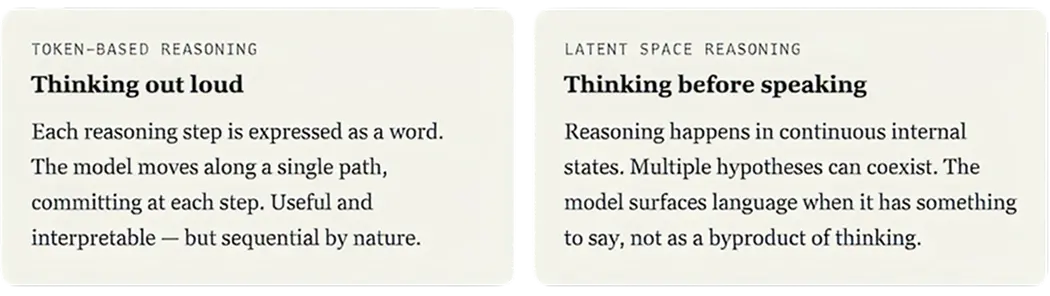
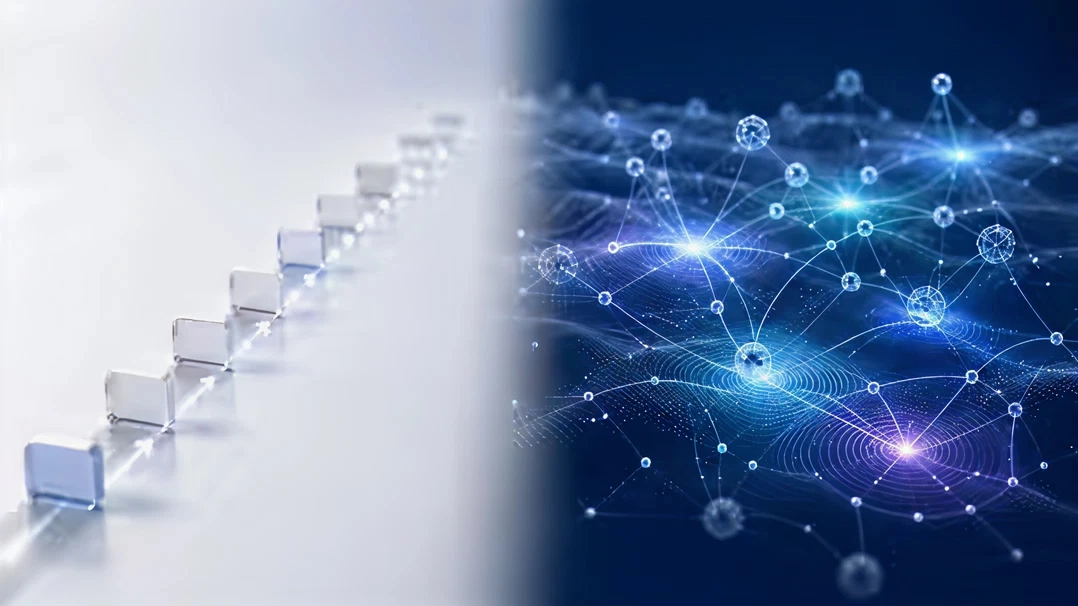
Latent space is vastly more expressive than vocabulary. Where a word forces a discrete commitment, a continuous latent vector can encode shades of uncertainty, competing hypotheses, and relational structure simultaneously. It can hold multiple possibilities in superposition until there’s enough information to resolve them.
Cognitive science offers a compelling parallel here. Research on patients with severe aphasia — who lose the ability to produce or understand language — shows that complex abstract reasoning, spatial thinking, and logical judgment can remain entirely intact. The brain’s reasoning systems and its language systems are largely distinct. Language, it turns out, is primarily a communication interface, not the substrate of thought itself.
Why continuous representation opens new doors
When a model reasons in continuous latent states rather than discrete tokens, several capabilities become more natural.
Reasoning depth is no longer directly coupled to output length. A model can perform more computation internally before surfacing an answer — without requiring a long visible chain of intermediate steps. The depth of thinking doesn’t have to be proportional to how much the model writes.
The model also isn’t committed to a single reasoning path the moment it begins. Because latent states don’t require the premature commitment of choosing a specific word, it becomes easier to hold alternative strategies open and revise internal representations as more context becomes available.
And abstract relationships — mathematical structures, spatial configurations, causal dependencies — can be represented directly in the geometry of the latent space, rather than being approximated through the nearest available vocabulary.
This is where HRM comes in
HRM is designed to operate in latent space, allowing reasoning to unfold internally before it is translated into language. Instead of forcing every step through words, HRM works within a continuous representational space where intermediate states and possible solution paths can be refined directly.
In this sense, latent space is not just a technical concept. It is the foundation for a different kind of AI architecture: one that thinks before it speaks.


Get In Touch
Sapient Intelligence is pursuing Artificial General Intelligence (AGI) by developing a next-generation, brain-inspired hierarchical latent-space architecture that overcomes the structural limitations of traditional AI frameworks. By integrating reinforcement learning (RL), evolutionary algorithms, and neurodynamic principles, Sapient develops models with advanced logical reasoning, lifelong learning, and high interpretability.